
Amnesty International’s Call For a War Crimes Investigation Against the US Doesn’t Go Far Enough
Why the language of the human rights organization’s plea for justice for an April 2025 massacre at a migrant detention center in the Arabian Peninsula misses the mark
If you find value in this article or in any of my other pieces, please consider becoming a paid subscriber.
The kind of in-depth, thoroughly researched journalism you read here takes a significant amount of time and effort to produce and your support will allow me to continue creating the type of content you’ve come to expect. A paid subscription is more than just access; it’s an investment in independent journalism and helps ensure this publication’s future.
As always, thank you for reading my work.
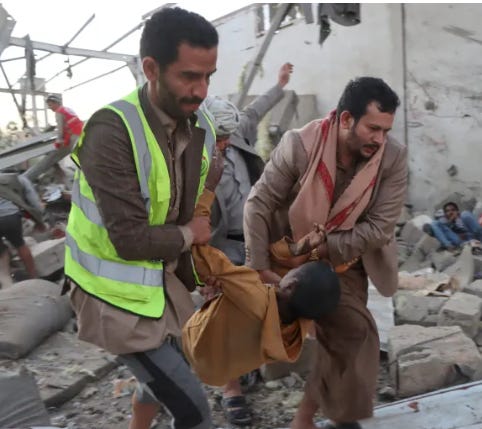
Three years earlier, a Saudi airstrike using US-made weapons killed more than 90 people in Yemen. Now, Amnesty International has insisted that the US must be held accountable for a horrific bombing last spring at a facility within the same prison complex.
As The Intercept noted in an article published in October, the circumstances surrounding this inexcusable, criminal strike are a complete mystery:
They noted that the facility had been used for years to detain immigrants and was regularly visited by the International Committee of the Red Cross. Amnesty further noted that it could find no evidence that the detention center was a military objective or that it contained any military objectives. Survivors told Amnesty International that, throughout their time in detention, they were able to see everyone who was present in the building and never saw any Houthi fighters.
Amnesty is absolutely correct in demanding consequences for the officials who ordered this strike, but some of the language that the organization leans on inadvertently does a disservice to the dead the group seeks justice for.
On April 28, 2025, a US airstrike hit a detention center in Saada, a relatively small city in the northwestern part of the country, killing at least 68 individuals. The victims who were held in the facility were African migrants that had been detained by the Houthis. Late last month, Amnesty marked the anniversary of the bombing with a comprehensive breakdown of the attack as well as the US government’s opaque “investigation” and refusal to obtain justice for the people who were killed.
In the lengthy press release, Amnesty said that the bombing should be “investigated as a war crime.”
However, in the very next paragraph, the group writes the following:
Rather than taking credible steps towards ensuring accountability, including through effective and prompt investigations, or providing reparations to harmed civilians, the US administration under President Donald Trump has gutted measures and mechanisms intended to prevent, mitigate and respond to civilian harm caused by US military operations abroad and has threatened attacks certain to cause devastating harm to civilians. [emphasis added]
Amnesty’s call for a thorough investigation and legal accountability echoes what every reasonable person should be demanding. However, the rhetoric the organization is using all but ensures that incidents like this will be repeated countless more times in the future.
After more than two decades of drone warfare, we know beyond any shadow of a doubt that the US government’s extrajudicial strikes mostly kill civilians.
It should be noted that even striking the people in our crosshairs is deeply problematic because the absence of due process ensures that individuals who are wrongly accused of this or that will be targeted. Since nobody in the US government ever faces any consequences for drone strikes gone wrong, these mistakes have occurred countless times since 2001 and will continue going forward. We coat these acts in phrases like “enemy combatants” and “the fog of war,” but the seemingly limitless nature of this system essentially means that the US has granted itself the right kill anyone, anywhere in the world, without any recourse for its actions.
Leaving that aside, a system like this guarantees that innocent people will get caught in the crossfire. This is quite simply the very nature of the US military’s indiscriminate death machine, a global system that’s become increasingly comfortable with shooting first and pretending to ask questions later. To acknowledge the reckless criminality of the drone program in one breath, and then pretend that it could be managed more effectively in the next is to wage a wholly artificial fight against American militarism. While there’s certainly no reason to believe that it was intentional on Amnesty’s part, this is essentially the effect that messaging like this has.
In its press release, the organization lamented the Trump administration’s “contempt” for “rules and restraints intended to mitigate civilian harm,” but as this publication has previously covered, trying to restructure an institution which cannot be reformed is a fool’s errand.
“The Trump administration’s approach to its air strikes in Yemen from March to May 2025 should have set off alarm bells in the USA and around the world, clearly signaling an urgent need to strengthen measures to protect civilians. Instead the US administration has systematically weakened safeguards, shrinking offices aimed at reducing civilian harm, while simultaneously displaying a dangerous disregard for the lives of civilians endangered by armed conflicts. Against that backdrop, attacks such as the US attack on a school in Minab in Iran, which killed 156 people including 120 children, were a tragically foreseeable consequence of a failure to implement robust civilian-harm mitigation efforts,” said Nadia Daar, Director of Amnesty International USA.
The only measure that would actually protect civilians is abolishing the US military’s standing policy of treating an entire region on the other side of the world like a battlefield.
Amnesty’s mention of the “measures and mechanisms” gutted by the Trump administration is a reference mainly to the Biden-era PR stunt known as the Civilian Harm Mitigation and Response Action Plan that was released in August 2022. In January of that year, officials were directed to develop the initiative by Lloyd Austin, the Raytheon board-member-turned-defense-secretary.
To borrow an old cliché, I read it so you don’t have to. The document – 46 pages of absolute gibberish – is filled with corporate jargon about organizing workflows and identifying best practices, but contains very little substance. As with so many endeavors like this, the plan tries to sell the reader on the premise that the authors are tackling a hitherto foreign subject that requires “DoD-wide analysis, learning, and training” to comprehend.
In reality, why so many innocent civilians have been killed by America’s bombs is far from a mystery. When a military spends 25 years firing at targets that are nothing more than a blinking cellphone signal flashing across some analyst’s screen, it’s kind of hard to expect a different result.
If Joe Biden’s Pentagon really wanted to understand why the casualty rates from the US government’s operations were so high, it could’ve considered some of the things President Obama engaged in while Biden was serving as vice president.
Thanks to the documents unearthed by whistleblower Daniel Hale, we know about the Obama administration’s use of “baseball cards,” the single-page tear sheets compiled by intelligence analysts about individuals destined for the president’s kill list. On the desk of Barack Obama was a Sears catalogue of assassination prospects and every once in a while, the former constitutional law professor would call in an order.
The administration spoke frequently about its commitment to only proceeding with a strike if/when it had near certainty that it was targeting a “combatant,” but consistently blew up schools and hospitals, incinerated wedding parties, and destroyed residential buildings while children slept in their beds.
The aforementioned report pretends to be unaware of this blatant disregard for human life and puts forth a seemingly pointless faux solution that does nothing to address the problem it’s pretending to care about.
In the report’s introduction, the DoD writes the following:
Hard-earned tactical and operational successes may ultimately end in strategic failure if care is not taken to protect the civilian environment as much as the situation allows including the civilian population and the personnel, organizations, resources, infrastructure, essential services, and systems on which civilian life depends.
By stating that the US military’s intent is to protect civilians “as much as the situation allows,” the Pentagon is setting a goal that’s impossible to quantify, rendering the remainder of the report effectively useless.
Here are some of the “goals” that the report says it aims to accomplish.
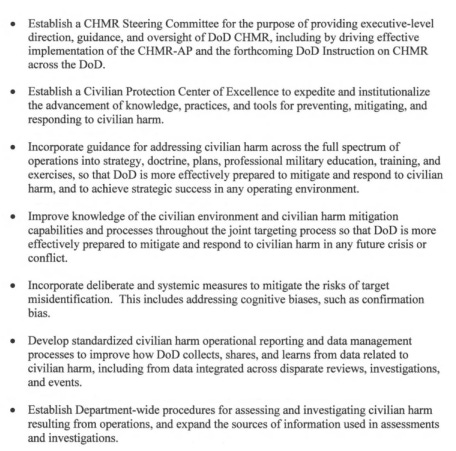
This kind of slop – boilerplate lingo about assessments and evaluations, and flow charts about the Plan’s newly established the Civilian Protection Center of Excellence – continues for 40+ more pages.
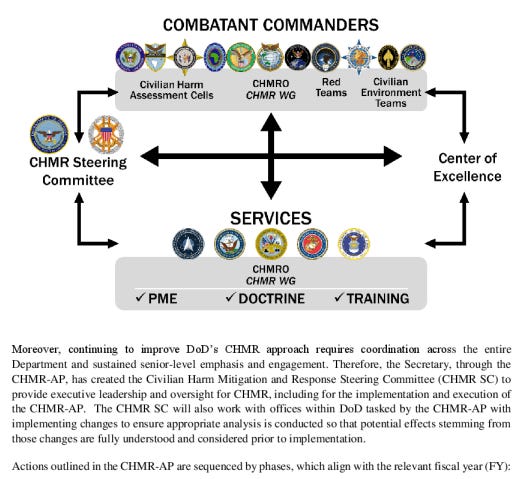
When the document was first released to the public, the Plan’s third objective stated that the DoD would be updated “once the definition of the term “civilian environment” has been tested, defined, and incorporated in joint doctrine.”
This is how most of the document reads… a mindless exercise in saying plenty without saying anything at all.
Predictably, there was a world of difference between what the Pentagon said it wanted to do and what it actually did, as America’s drone war continued interrupted.
Using raw data aggregated from the Armed Conflict Location & Event Data Project (ACLED), a US-based non-profit, a number of publications have reported that the US military launched 494 drone strikes during Joe Biden’s presidency. According to the figures provided by ACLED, with strikes that were conducted alongside coalition partners, that number rises to 694.
It’s impossible to know just how many civilians were killed in these strikes because the US government has never been honest about this data. Even if it wanted to be, the US military often isn’t even aware of just how many fatalities its bombings produce.
Again, we need to consider what the White House got away with during Biden’s term as vice president.
On a Friday afternoon in 2016 – as the country was preparing for the long July 4th weekend – the Obama administration revealed the government’s drone statistics for the previous two terms. This data set – released at a time when the administration knew few people would be paying attention – stated that the US had killed between 64 and 116 civilians in Libya, Pakistan, Somalia, and Yemen, between 2009 and 2015. This total, instantly dismissed as being far too low by a number of organizations tracking airstrike casualties, was paired with another set of numbers.
The administration said that between 2,372 and 2,581 “enemy combatants” were also killed by its drone program during this same time period. Of course, nobody can really be certain about who these individuals were. As the now infamous 2012 New York Times article on President’s Obama “kill list” noted, all military-aged males in a strike zone would be classified as combatants “unless there is explicit intelligence posthumously proving them innocent.”
The document generated headlines, but kept the US military’s practice of continuous strikes intact. How successful this initiative was at reducing civilian harm will never truly be known because the US government has always lied about the data it’s released. And while a reduction would of course be inherently positive, it is crucial to once again emphasize that less criminality is still criminality.
The Trump administration’s foreign policy record, by pretty much every measure, has been absolutely abysmal.
In early 2025, The Atlantic Editor-in-Chief Jeffrey Goldberg was inadvertently added to a group chat in which a set of strikes that were launched at the Houthis later that same day were being discussed. The transcript of these conversations revealed that the US military knowingly destroyed a residential apartment building because it wanted to kill a single combatant.
“The first target — their top missile guy — we had positive ID of him walking into his girlfriend’s building and it’s now collapsed,” National Security Adviser Mike Waltz was quoted as saying.
“Excellent,” IS Vice President JD Vance’s response.
Indiscriminate targeting like this is particularly evil, but even more “careful” planning always carries an extraordinarily high risk of killing innocent people. The US government wanted a pat on the head for making its execution workflow more efficient, and that speaks volumes about how little it values human life past its own shores.