
The Selective Outrage Guiding the Pushback to Selling F-35 Jets to Turkey
A growing chorus of lawmakers opposes reauthorizing Turkey’s inclusion in the F-35 program. Ankara’s authoritarian impulses and documented human rights abuses have nothing to do with their objections.
If you find value in this article or in any of my other pieces, please consider becoming a paid subscriber.
The kind of in-depth, thoroughly researched journalism you read here takes a significant amount of time and effort to produce and your support will allow me to continue creating the type of content you’ve come to expect. A paid subscription is more than just access; it’s an investment in independent journalism and helps ensure this publication’s future.
As always, thank you for reading my work.
In 2019, the Trump administration opted to block Turkey’s purchase of more than 100 F-35 fighter jets following the latter’s decision to purchase the Russian S-400 missile system.
At the time, the US government envisioned this as a conflict of interest that could potentially threaten America’s national security by enabling Moscow to gain critical proprietary information about the F-35. The Pentagon was reportedly concerned that these data breaches would compromise the F-35’s stealth capabilities. The Countering America’s Adversaries Through Sanctions Act (CAATSA) of 2017 mandated the US government to place sanctions on any nation that purchased military equipment from Russia. The 2020 National Defense Authorization Act further codified this restriction into law, restricting the transfer of the aircraft until Turkey was able to prove that it was no longer in possession of the S-400.
Because the US government has never hesitated to arm despotic regimes, this decision had no connection to the Turkish government’s barbaric foreign policy, support for extremist groups, or the horrific treatment of its people. And of course, the revelation last week that President Trump is weighing a reversal in policy doesn’t mean that anything has changed.
For all intents and purposes, it’s the same dumb script Washington’s been reading from for years.
Donald Trump announces that he intends to pursue a destructive foreign policy that flies in the face of the values the US claims to uphold, and most of the MAGA loyalists in Congress smile and nod. A sizeable contingent of Democrats disagrees, but for all of the wrong reasons, given that they couldn’t care less about these principles either.
Even though President Recep Tayyip Erdoğan has engaged in the same type of behavior the US typically starts wars over, nothing really changes. Despite all of the reasons why it shouldn’t, Turkey – a NATO ally – will continue to receive US weapons and possibly the F-35.
Washington’s relationship with Ankara is one of the best illustrations of the US government’s hypocritical and opportunistic modus operandi on the world stage.
**
A reauthorization to once again sell F-35s to Turkey would be nothing more than a continuation of a longstanding arms pipeline between the two nations.
Just within the past year, the DoW’s Defense Security Cooperation Agency announced US government approvals for shipments of two types of missile systems to Turkey. In June, the Trump administration made clear that it was planning to barrel past congressional concerns on a $700 million sale of F110 engines for Turkey’s KAAN combat jet. In 2024, the country was approved by the US State Department to receive $23 billion worth of F-16 jets and upgrades.
In spite of Washington’s rhetoric about its supposed dedication to protecting freedom and democracy around the world, all of these sales were made despite Turkey’s repressive style of governing and abysmal human rights record. Throughout the years, President Erdoğan’s administration has repeatedly been documented prosecuting journalists, banning political parties, punishing dissidents, and criminalizing free speech.
One of the most egregious examples of this overreach stemmed from a small 2013 sit-in by a group of environmental activists who were protesting plans to turn a park into a luxury shopping mall.
After images of government forces setting fire to the protesters’ belongings and firing tear gas into their tents ricocheted around social media, the entire country took to the streets, with more than 3.5 million people marching in dozens of Turkish cities within a matter of days. The anger about the government’s reaction to the demonstration blended with the public’s general frustration with Ankara’s increasingly authoritative tendencies.
In the wake of the coup attempt by the Turkish military during the summer of 2016, the country continued to shift further and further from democratic norms. Erdogan’s administration became even stricter, with seemingly little to no tolerance for any type of political opposition. For the offense of voicing political viewpoints that the government wasn’t fond of, thousands of academic professionals were removed via government decree from their positions.
In January of that year, the government cracked down on the “Academics for Peace,” the more than 2,200 individuals that signed a petition calling for a peaceful resolution to Ankara’s conflict with the Kurds.
Following indictments under a section of Turkish law which criminalizes the act of “making propaganda for a terrorist organization,” more than 200 individuals were handed prison sentences of between one and three years. Most of these sentences were reversed following a ruling by the Constitutional Court, but the damage had been done.
Expression Interrupted, which tracks jailed journalists and academics in Turkey, summarized this persecution via the following passages:
Only 15 of 406 academics who had been dismissed through statutory decrees for signing the petition were reinstated as per decisions by the State of Emergency Commission.
…
But behind the numbers were real people, their lives and careers: some of them were excluded from scientific conventions even though their papers had already been accepted; some were denied appointment to posts or promotion; some of them had their ongoing projects canceled by the Scientific and Technological Research Council of Turkey (TÜBİTAK); some were barred from participating in scientific conventions abroad by the administrators of the universities they worked at. For academics who signed the petition as PhD students and completed their graduate studies during the legal process, finding a job in any university in Turkey became literally impossible.
During the first six months of the process, some signatories were forced to leave Turkey, especially those who were dismissed or forced to resign from their posts. After the dismissals, restrictions were imposed on the passports of these academics and therefore, those who were abroad at that time did not return to Turkey since they would neither be able to go back nor work in Turkey, forcing many academics to live in exile.
According to a 2019 New York Times report, three dozen of these individuals still went to jail.
The same government that perpetrated this injustice – the country we’ve spent years arming – is the same one that’s ordered the dissolution of 19 political parties since 1982.
Just a few years ago, Turkey continued this wholly undemocratic tradition by also attempting to dissolve the Peoples’ Democratic Party, the second-largest opposition party in the country’s parliament. Human Rights Watch detailed the following in a January 2023 article about this process:
The Constitutional Court is currently being asked to order the closure of the Peoples’ Democratic Party (HDP), a political party with 56 deputies in Turkey’s parliament. An indictment against the party seeks to ban 451 politicians and party members from organized political activity or membership of political parties for a period of five years and forfeiture of the party’s assets.
The case before the Constitutional Court is based on a June 7, 2021 834-page indictment that mainly asserts the HDP’s activities are carried out in line with the aims of the armed outlawed Kurdistan Workers’ Party/Kurdistan Communities Union (PKK/KCK). According to the indictment, there is an “organic” link between the PKK/KCK and the HDP’s activities which the prosecutor claims support separatism by being “in conflict with… the indivisible integrity of the State with its territory and nation,” a violation of article 68/4 of Turkey’s Constitution and provisions in the Law on Political Parties.
The European Court of Human Rights (ECtHR) has found that party closure decisions violated the European Convention on Human Rights in six out of seven of the cases from Turkey it has examined.
The NGOs emphasized in their submission that in all the cases of parties representing the interests of Kurds submitted to the ECtHR, the court found that peacefully advocating the right to self-determination and recognition of Kurdish language rights or Kurdish identity were not themselves contrary to the fundamental principles of democracy, and that party closure violated the right to association. The ECtHR determined that in most cases the dissolution of those parties could not reasonably be said to have met “a pressing social need”.
Although this particular effort proved to be unsuccessful, it speaks volumes about the US government’s ally and weapons recipient.
The Turkish government also banned 131 media outlets in the immediate aftermath of the coup attempt; at this time, roughly one-third of all imprisoned journalists around the world were imprisoned in Turkey.
Just last week, The Guardian reported the following:
Authorities in Turkey have widened a crackdown on public life, arresting more than 200 people during raids across Ankara last month, jailing a comedian and blocking a cruise ship carrying LGBTQ+ passengers from docking in the run-up to the Nato summit in the capital.
The arrests followed a ban on demonstrations in Ankara that was put in place until 10 July. Human Rights Watch (HRW) said this was evidence of Turkey’s “ruthless intolerance of freedom of speech and assembly”. The watchdog group said the Nato summit, which starts on Tuesday, was taking place in the context of intensifying violations of basic rights, “including far-reaching restrictions on the main political opposition party, the media, and freedom of expression in general”.
Last week, the standup comedian Deniz Göktaş was arrested and put in pre-trial detention after arriving at Istanbul airport from a holiday. Göktaş was charged with “insulting the president” and “denigrating religious values” in relation to a show in which he referred to the Turkish president, Recep Tayyip Erdoğan, as a dictator and made jokes about suicide bombers. The performance took place in Istanbul on 1 June and a recording was released on YouTube on 24 June. The video has been viewed nearly 9m times.
All of these things should [theoretically] be cause for concern for Western governments that claim to be fighting for democracy around the world.
However, these issues pale in comparison to the Turkish government’s militarism in the region.
Back in 2016, Ben Norton, who runs the Geopolitical Economy Report page on Substack, encapsulated how Turkey blends a repressive and totalitarian style of government at home with an unapologetically dangerous set of foreign policies across the Middle East:
Erdoğan has never treated journalists well. According to the Committee to Protect Journalists, NATO ally Turkey has in recent years imprisoned more journalists than any other country — including longtime U.S. enemies China and Iran. (This didn’t stop the aspiring sultan from boasting “Nowhere in the world is the press freer than it is in Turkey. I’m very sure of myself when I say this.”)
Yet Erdoğan is now upping the repression to the next level. His Western-allied regime has redefined dissentious journalists and activists as “terrorists.”
On the same day Erdoğan made these remarks, the U.S. State Department released a statement stating “We reaffirm our strong partnership with our NATO Ally Turkey in combatting the shared threat of terrorism.”
This is fascinating, considering the country’s well-documented support for the extremist groups the U.S. is ostensibly fighting in the War on Terror.
Former U.S. ambassador to Turkey Francis Ricciardone admitted in 2014 that Turkey has directly supported al-Nusra, al-Qaeda’s wing in Syria.
These flagrant violations are coupled with Turkey’s brutality against the Kurds, who’ve spent years attempting to carve out an independent nation in the region. Turkey’s past campaigns against the Kurds – primarily the Kurdistan Workers’ Party (PKK) in southeastern Turkey and northern Iraq, and the People’s Protection Units (YPG) in northern Syria – have killed thousands and displaced hundreds of thousands more.
In January 2018, for instance, the Turkish military launched Operation Olive Branch, an offensive with the objective of gaining control of Afrin, the Kurdish-controlled enclave in northwestern Syria. For weeks, Turkey’s repeated strikes and subsequent ground invasion devastated civilian targets, killing hundreds of people and forcing an estimated 150,000 ethnic Kurds to permanently flee their homes. The following year, Turkey bombed the Kurdish-led Syrian Democratic Forces, resulting in another 200,000 Kurdish refugees.
These should’ve been red lines for the US government’s arms trade with Turkey, that is, if Washington actually cared about the things that it claims to care about. For years, however, none of this had any effect on the relationship between the two nations. Turkey’s purchase of the S-400 system, however, is not something that the US government has been willing to tolerate.
Prior to the White House’s July 2019 decision, Turkey was angling to purchase more than 100 F-35s to replace its F-16 fleet. It’s also worth noting that Turkey wasn’t just a customer of the F-35. It had also been one of eight countries involved in the co-production of the fighter jet since the program was first conceived in 1999. At the time, Turkish manufacturers produced more than 900 parts for the F-35, including components for the plane’s fuselage and landing gear.
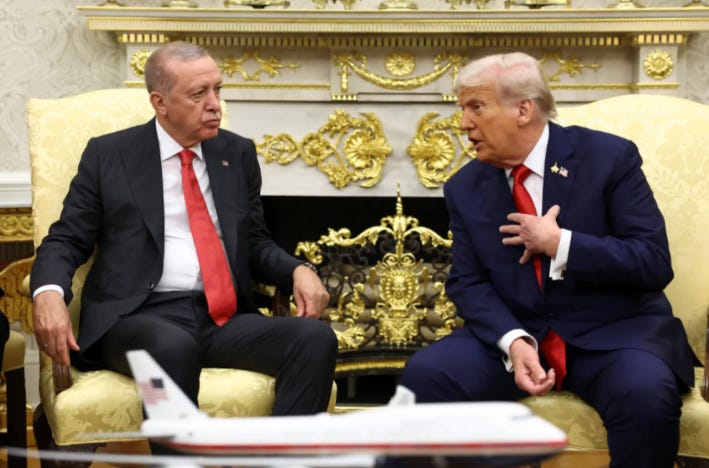
None of these things deterred the US from arming Turkey prior to the latter’s S-400 deal with Russia. Now that Turkey has agreed to transfer the system it’s purchased from Moscow to a third country, the F-35 deal is back on the table. A number of reports indicated that Trump was expected to discuss the matter with President Erdogan at the NATO summit that took place in Ankara last week.
Reports about Erdogan’s government banning political parties, beating and jailing dissidents, and killing American allies had never prompted widespread congressional opposition to sending military equipment to Turkey. The prospect of Trump’s reversal on the F-35 program was a different matter.
In a July 2 letter addressed to the White House, a bipartisan group of House members urged the president to reconsider moving forward with the reauthorization.
After reiterating the dangers of selling Turkey the F-35s while the country was still in possession of the S-400 air defense system, the letter also included the following:
Since 2019, President Erdogan has only further antagonized the U.S. and our NATO allies. Turkey continues to maintain a military presence in the northern occupied part of Cyprus and has engaged in aggressive actions toward Greece due to recurring maritime and air disputes. Further, there is constant and growing anti-Israel rhetoric, all while Turkey maintains bilateral relations with Iran. While Turkey has been a NATO ally since 1952, they have hardly been a reliable partner in the present day. [emphasis added]
As if further proof was needed, this letter is yet another example of the completely fabricated notion that Democrats and Republicans can’t agree on anything. Nothing brings the two parties together like the opportunity to antagonize an enemy of the West, while denouncing criticism of the one foreign country that you’re simply not allowed to criticize as a member of the United States Congress.
Official death toll figures indicate that the Israeli government has killed more than 73,000 people in Gaza since October 2023; every news agency and aid organization on the ground tells us that the real number is significantly higher. Nearly a month ago, reports showed that the IDF has now killed more than 1,000 people in Gaza just since the so-called “ceasefire” that was announced in October.
According to the country’s health ministry, Israel has also killed more than 4,000 people [while displacing more than one million] in Lebanon since March.
While Turkey’s human rights violations have generally been met with silence on Capitol Hill, criticism of Israel – even as Israel continues to commit genocide – prompts immediate pushback.
The concerns that are outlined in this letter mirror very closely the points delivered by Israeli Prime Minister Benjamin Netanyahu.
“The other thing I’d like to say, because we’re on the verge of the president’s going to Turkey … I don’t think they should be given F-35s or the engines for their fighter jets,” Netanyahu was quoted as saying last week. “Because that’ll upset the power balance in the Middle East, which is ultimately guaranteed by Israeli air superiority, and also by, I think … America’s posture in the Middle East.”
It is far from a coincidence that the 10 signatories of the letter – who have all taken cash from AIPAC, the immensely influential lobbying firm that essentially dictates the course of US-Israeli relations to most members of Congress – are in such close agreement with the prime minister.
When the US government has a geostrategic motive to exploit another country’s natural resources or remove a democratically elected government, it will often accuse its leader of doing the kinds of things Erdoğan’s been doing for years.
America’s relationship with Turkey serves as further proof that the whole of American foreign policy is based on lies.
Just more evidence that American foreign policy makes no sense. We have two "allies" that hate each other and that is just for a start.
We need to come home, but we won't.
Everything eventually reduces to its absurd.
"Operation Olive Branch" The guy who came up with this may be a low life swine, but give him the sense of humor, evil though it might be.