
The Pentagon’s Mock ‘Investigation’ Into the Iran School Bombing
Pete Hegseth has promised a comprehensive probe of the attack. History tells us that justice for the strike that killed at least 175 will never be found.
If you find value in this article or in any of my other pieces, please consider becoming a paid subscriber.
The kind of in-depth, thoroughly researched journalism you read here takes a significant amount of time and effort to produce and your support will allow me to continue creating the type of content you’ve come to expect. A paid subscription is more than just access; it’s an investment in independent journalism and helps ensure this publication’s future.
As always, thank you for reading my work.
In the opening hours of the war, an incorrect data set produced target coordinates that turned a school in Iran’s southern Hormozgan Province to rubble.
People briefed on a preliminary investigation told the New York Times that officials at US Central Command [CENTCOM] had relied on inaccurate information for the February 28 strike provided to them by the Defense Intelligence Agency. The US military was targeting an Iranian Revolutionary Guards Corps naval base but struck the Shajarah Tayyebeh elementary school instead. As a result, at least 175 individuals, mostly children, were killed, and another pointless and offensive American conflict was underway.
Rumors spread across the internet that a missile misfired by Iran was responsible.
Videos geolocated and verified by news outlets around the world, as well as expert analysis of still frames of the Tomahawk seconds prior to the strike quickly put this speculation to rest. Neither Iran nor Israel possess Tomahawk missiles, and the US military even released video of these munitions being launched from a warship just a few hours prior to the strike.
“Oh, I think the munition that is visible in that video is clearly a Tomahawk. It’s long, cylindrical, it has a set of wings, and really no other country in this conflict has a munition that looks like that,” weapons expert Jeffrey Lewis, who serves as the director of the East Asia Nonproliferation Program at the Middlebury Institute of International Studies, told NBC News.
“No, in my opinion, and based on what I’ve seen, that was done by Iran,” President Trump stated without a shred of evidence while speaking to reporters aboard Air Force One on March 7.
“You just suggested that Iran somehow got its hands on a Tomahawk and bombed its own elementary school on the first day of the war. But you’re the only person in your government saying this. Even your defense secretary wouldn’t say that when he was asked, standing over your shoulder on your plane on Saturday. Why are you the only person saying this?” New York Times correspondent Shawn McCreesh asked the president two days later.
Two days after that, the Times published the aforementioned piece linking the US military to the strike.
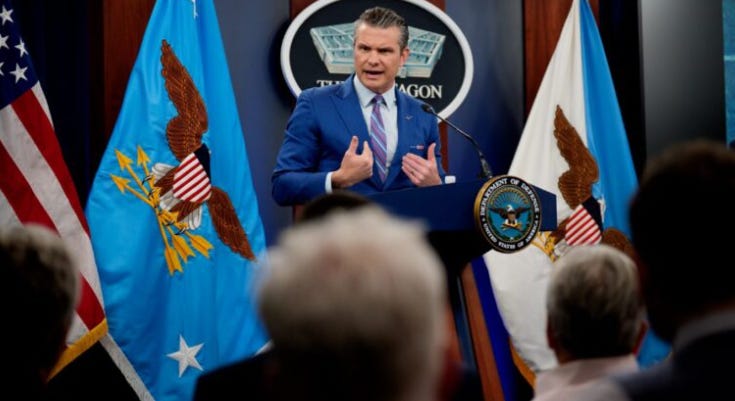
During a press conference on March 13, Secretary of War Pete Hegseth announced that “CENTCOM has designated an investigating officer to complete a command investigation” of the incident.
“The command investigation will take as long as necessary to address all the matters surrounding this incident…” Hegseth added.
This makes it seem like the Pentagon is interested in accountability, but past probes of this nature tell a different story. US promises to dig into its military’s operations overseas are exercises in public relations, not justice. Ultimately, these faux investigations almost always go nowhere.
During the Biden administration, the Pentagon said that it would look into the August 29, 2021, Kabul drone strike that ended the US military’s 20-year occupation of Afghanistan. In this final act of the war, the US struck aid worker Zemerai Ahmadi’s car – that US officials said they believed he had been filling with explosives, but were actually water jugs – murdering him and nine of his family members.
The incident wasn’t that much different than the countless others that had come before it, but because it generated headlines, the US government agreed to conduct a probe. In November of that year, the administration’s “independent” review found that the strike was not the result of any type of misconduct or negligence. According to the announcement, the Pentagon did not recommend any disciplinary action for any of the parties involved.
The US incinerated Ahmadi’s car precisely when every news outlet on the planet had its cameras pointed at Kabul. Under almost any other set of circumstances, it’s likely that the incident would’ve been forgotten about as quickly as any of the other thousands of bombs we’d dropped on Afghanistan since 2001.
During a briefing that fall, General Frank McKenzie, then the commander of US Central Command, said that he was “fully responsible” for the August 29 strike, but it was unclear as to what exactly that meant. The general hadn’t been indicted. He hadn’t resigned. He simply apologized, and the US government, along with the press corps and the country, moved on.
In this regard, there has never been a different outcome. Since the dawn of the “war on terror,” not a single senior government official, cabinet member or senior military official has faced any criminal legal consequences for any specific strikes or actions overseas. Even when the US admits that it was at fault, administrative slaps on the wrist are always the most severe penalties that are handed out.
After US airstrikes killed 12 Doctors Without Borders/Médecins Sans Frontières (MSF) staff members, along with at least 10 patients, at the Kunduz Trauma Centre in October 2015, the organization released a statement in which it noted that “not a single member of our staff reported any fighting inside the MSF hospital compound prior to the US airstrike on Saturday morning.” The statement – which referred to the incident as a “war crime” – also specified that the bombing took place despite the fact that MSF had provided the hospital’s GPS coordinates to US and Afghan forces.
At the time, Army Gen. Joseph L. Votel, the commander of Central Command, also offered an apology.
In a statement, the general attributed the strike to “communications and equipment failures and human error compounded by the stress of combat.”
The Pentagon announced that 16 service members were “disciplined” for the incident. The press release relaying this development indicated that these individuals “received appropriate administrative or disciplinary action, including suspension and removal from command, letters of reprimand, formal counseling and extensive retraining.” That was it.
Even “consequences” as mild as these are an uncommon occurrence. More often than not, the cases are swept under the rug and are instantly forgotten.
Since 2001, there have been a few dozen incidents in which the US government has punished lower-level members of its military, when a particular act was far too egregious to ignore. During his first term, President Trump made sure that some of these rare instances of accountability were reversed.
In 2019, Trump announced that he would pardon three service members who had all been convicted of committing war crimes in Afghanistan. On his way out the door, Trump also issued full pardons to four Blackwater security contractors convicted of slaughtering 14 Iraqis in Nisour Square in 2007.
As this publication covered during the secretary’s confirmation hearings during the transition, Hegseth played an integral role in steering the president toward these decisions long before leading the Pentagon:
Hegseth talks a big game about listening to the individuals with “dust on their boots” – a line he repeats ad nauseam – but the circumstances surrounding the most prominent soldier he convinced Donald Trump to pardon all but demolish the premise that these prosecutions should be viewed as attacks on the military.
The servicemember in question is Special Operations Chief Edward Gallagher, who was serving with SEAL Team 7 when his own platoon alerted US officials of disturbing criminality they’d said they’d witnessed Gallagher engage in.
In September 2018, Gallagher stood accused of fatally stabbing an injured 17-year-old ISIS prisoner in US custody.
The following July, a jury convicted Gallagher of photographing himself with the teenager’s corpse but acquitted him of all other charges. This occurred when Special Operator Corey Scott – testifying under a blanket of immunity – told the court that he and not Gallagher had been responsible for the killing.
Several days following the murder of the prisoner, Gallagher texted a photo of himself to friends in the US. In the image, Gallagher reportedly held the captive’s hair in one hand, and a small hunting knife by the prisoner’s neck in the other. Gallagher paired the photo with a text that read “Good story behind this, got him with my hunting knife.”
When he was sentenced, Gallagher was demoted from an E7, Chief Petty Officer, to an E6, Petty Officer First Class, a downgrade that would’ve affected his salary and pension. A few months later, President Trump decided to override that decision and restored Gallagher to his previous E7 paygrade.
On November 4 of that year, Hegseth told Fox viewers that he “was able to confirm yesterday from the president of the United States himself, the commander-in-chief, that action is imminent” on restoring Gallagher’s rank and pay. During that segment, Hegseth said that “… this president recognizes the injustice of… you train someone to go fight and kill the enemy, then they go kill the enemy the way someone doesn’t like, and then we put them in jail, or we throw the book at them…”
To be clear, in this context – because Gallagher had previously been accused by his fellow SEALs of assassinating a young girl and an elderly man from a sniper’s roost – the “enemy” Hegseth references appears to be any civilian that gets caught in the US military’s crosshairs.
During his time at Fox News, Hegseth advised the president behind the scenes, lobbying him to pardon American soldiers accused of shocking and disturbing war crimes in Iraq and Afghanistan. As the Daily Beast reported in 2019, Hegseth appears to believe that US servicemembers should have the authority to operate with impunity while serving overseas: On Sunday, Hegseth said on Fox & Friends Weekend that he “can’t stand” news outlets referring to the charges against [Edward] Gallagher as war crimes. “These are men who went into the most dangerous places on earth with a job to defend us and made tough calls on a moment’s notice,” he said. “They’re not war criminals, they’re warriors.” In fact, he has dismissed the soldiers’ alleged crimes as simply having made “tough calls” on at least eight separate occasions this year.
It’s important to note that while cases like this have involved things like soldiers shooting unarmed non-combatants at close range or opening fire into a crowd of civilians, they’ve never involved anyone in any position of power. In other words, the US government will occasionally prosecute lethal choices made by individual service members, but the American public has no mechanism in place for holding its elected leaders criminally accountable for policy choices connected to foreign policy.
This is a legal shield that officials like Hegseth regularly defend because they insist that having it is the only way to effectively manage the Pentagon’s ongoing operations, but this implies that these wars are both necessary and unavoidable. This is simply not the case.
Our secretary of war, for instance, constantly talks about “the battlefield,” but what he’s actually describing are the residential neighborhoods of the sovereign countries the US has chosen to occupy, illegally and indefinitely. He’s always referencing “the warrior culture,” but what he really means here is blowing up hospitals and refugee camps on the other side of the world.
Asking the government to investigate itself is pointless and rarely, if ever, yields results.
The US military has dropped hundreds of thousands of bombs since September 11, 2001. In essence, the executive branch has no interest in seeking justice for these victims because bombings like the February 28 strike aren’t a bug of American foreign policy, they’re a feature.
Incidents like the Shajarah Tayyebeh massacre can’t be dismissed as mistakes because the ungodly frequency of these strikes and the extremely high rate of failure means that the indiscriminate murder of civilians is baked into the equation.
In 2021, Airwars, the non-profit watchdog which tracks civilian harm claims in conflict-affected nations, published a comprehensive report analyzing the Pentagon’s seven most intensive campaigns: Afghanistan, Iraq, Syria, Libya, Somalia, Yemen, and Pakistan. Airwars acknowledged that sorting through the data was a challenge; oftentimes it was nearly impossible to separate deaths caused by US airstrikes from those launched by our partners, or artillery and other munitions. Nevertheless, the data its researchers compiled indicated that US strikes in these theaters had killed between 22,679 and 48,308 civilians since 2001. The total has only increased in the years since the report was first released.
“But I will note to this group and to the world, there’s only one entity in this conflict between us and Iran that never targets civilians, literally never target civilians,” Hegseth told reporters during the same press conference. “I look at the process that’s used on dynamic strikes or on boat strikes and others. We have a very high fidelity process in that case. So we don’t target, Iran does.”
Statements like this are absolute nonsense because the US military knows, with absolute certainty, that drone warfare kills a disproportionate number of civilians, but still opts to perpetuate these types of strikes time and time again. This renders every attempt by the US government to excuse outcomes like the one at the Shajarah Tayyebeh school as unintentional errors caused by the fog of war as completely meaningless.
The US military wasn’t aiming for the school. However, the Pentagon’s utter disregard of recent history and the extraordinarily high possibility that innocent people would be killed makes conversations about intentions a complete sham.
The US government doesn’t care about killing civilians, almost never holds anyone accountable for doing so, and, despite Hegseth’s promise, isn’t about to start now.
This new “investigation” is just for show.