
Former CENTCOM Commander Pens Infuriating Op-Ed Enthusiastically Supporting Yemen Strikes
Kenneth McKenzie’s foreign policy views in retirement are as noxious as his actions were during his time in power
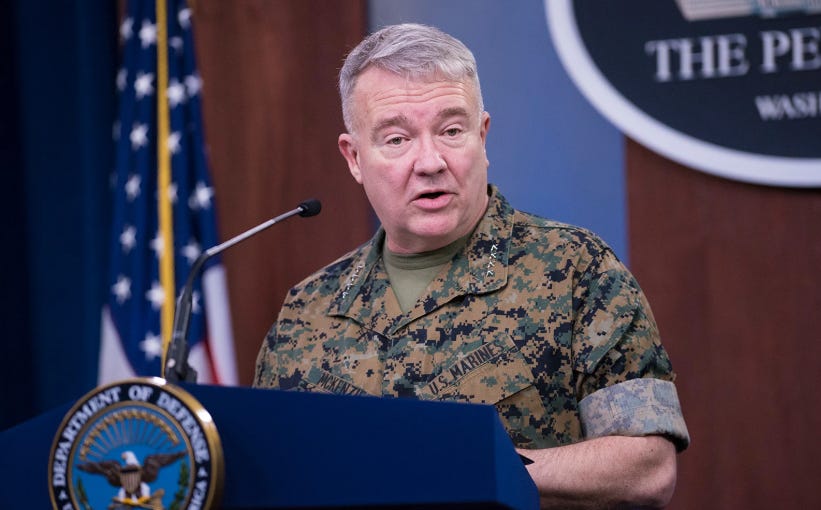
Kenneth F. McKenzie Jr.’s op-ed in the New York Times about the recent controversy surrounding the Trump administration’s use of the Signal messaging app epitomizes so much of what’s wrong with the current state of affairs.
McKenzie begins the April 6 piece by addressing the scandal that erupted after The Atlantic Editor-in-Chief Jeffrey Goldberg was inadvertently added to a group chat in which a set of strikes that were launched at the Houthis later that same day were being discussed. In his write-up, the retired Marine Corps general’s chief complaint is that all of the hubbub about protecting classified material and operational planning pulled attention away from how necessary the US military’s March 15 Yemeni strikes actually were.
It's far from a surprise that the Times would lend such coveted real estate to a perspective like this one, and even less shocking that it comes from someone like McKenzie.
McKenzie summarizes a lot of his reasoning for what he deems to be “a necessary military campaign and a potential turning of the page for the United States in the Middle East” with the following paragraph:
The Biden administration mostly chose to ignore the growing threat to world commerce posed by the Houthis, an Iranian-backed group that President Trump has designated a terrorist organization. Its responses were telegraphed and thoroughly watered down to avoid any possibility of escalation by Iran and, concomitantly, any lasting damage to the Houthis. As a result, the impact on the group was ephemeral at best.
The first section repeats a false premise Republicans never tire of recycling.
The Biden administration authorized strikes against the Houthis for months during his final year in office. As has so often proven to be the case since the earliest days of the so-called “War on Terror,” the overwhelming majority of the individuals our drones kill end up being innocent civilians. Despite the Pentagon’s repeated assurances to the contrary, there is little reason to believe that the same can’t be said for last year’s campaign.
The strikes were pointless and ineffective and did nothing to slow the Houthi militia’s disruption of shipping lanes in the Red Sea, but to suggest that this stems from the previous administration’s operations in the region not being brutal enough is insane.
The fact that McKenzie has opted to take this stance squares with his past helping quarterback multiple US wars and countless military missions.
The legacy media will never hesitate to provide individuals like McKenzie with a platform because the “knowledge” and “expertise” of former military commanders is a big part of how America sells its wars in the first place. It doesn’t matter how often the US military is proven to be wrong or how frequently their promises of limited engagements turn into decade-long quagmires. The American public continues to be fed the lie that the stars on a general’s shoulders come with some sort of inherent wisdom that the rest of the population does not and could not possibly possess.
Sure, you may oppose both Biden and Trump’s deadly bombings of some of the poorest people on earth because you’re against murdering civilians, but have you heard what this man who used to murder civilians for a living has to say? You may be highly skeptical of the Pentagon’s pursuit of generic goals, but here’s some insight from someone who spent his entire career falling short of objectives the US government could never be bothered to quantify or define. The media places individuals like McKenzie on an intellectual pedestal because it’s used to laundering the establishment’s wars through people many have been conditioned never to question, not because retired generals shouldn’t actually be challenged. It's a trick and the Times is happy to use it to try to manipulate its audience into supporting yet another foreign conflict.
McKenzie’s other comments about protecting “US interests” in the region are just as misguided and show why relying on senior military officials for commentary on foreign affairs is always such a terrible idea. In the op-ed, the former CENTCOM commander also writes the following:
By trying to assure safe passage through Bab el-Mandeb, the strait that leads into the Red Sea and is critical to international shipping routes, we’re doing much more than simply aiding European commerce. Instead, we’re pursuing several broader goals: First, we’re asserting the importance of free passage on the global commons; we are the world’s greatest maritime nation, and the concept of uncontested transit is fundamental to our security. Second, China is watching us and will draw conclusions from our actions with Yemen about what we will or will not tolerate happening to Taiwan.
This is much, much darker than it may appear, and only sounds innocuous because of how commonplace it’s become.
The transcript of the now infamous Signal chat shows Pete Hegseth, Tulsi Gabbard, and JD Vance celebrating one of the Pentagon’s bombs destroying an apartment building presumably filled with civilians. Published reports indicate that every other batch of strikes against the Houthis has produced largely the same results. The US government insists that it’s targeting Houthi militants, but the truth of the matter is that it can only guess who it’s actually hitting.
Freedom of navigation and protecting shipping lanes aren’t unimportant matters but they absolutely do not warrant the endless stream of attacks the last two administrations have launched.
The ease and comfort with which McKenzie justifies extinguishing and continuing to extinguish countless lives should alarm everyone. Nobody wants to see the cost of basic living expenses go up even further, but blowing up a French or a British village in pursuit of lower prices on blue jeans and Cheerios isn’t something anyone in the West would ever attempt to justify. Yet, for some inexplicable reason, it’s perfectly acceptable if the people being bombed are in Syria, Libya, Afghanistan, or in this case, Yemen.
His rhetoric about China is even darker.
Beltway insiders like McKenzie have now spent so much time fearmongering about our “pacing challenge,” that they sometimes don’t even stop to consider if what they’re saying even makes any sense. The notion that Beijing has its eyes on the Red Sea in an attempt to assess how we may someday act in the Taiwan Strait is a ludicrous premise.
China should have no illusions about our intentions with regards to Taiwan. The US government has authorized more than $21 billion in weapons systems that are currently waiting to be delivered to Taipei, while dozens of the highest-ranking officials in the country – this includes senior members of Democratic and Republican leadership, cabinet secretaries, as well as both Biden and Trump – have stated in no uncertain terms that an invasion of the island will automatically trigger an American military response.
The Pentagon has spent 70 years bombing dozens of countries on four different continents. It’s absolutely unnecessary for us to bury apartment buildings filled with children in piles of rubble in Aden just to reassure Chinese leadership that we’d also be willing to do the same in Guangzhou.
This reasoning is criminal, callous, psychotic, and unspeakably cruel, but McKenzie doesn’t hesitate to pursue it because people like him never suffer any consequences for killing people on the other side of the world.
Take, for instance, the August 2021 Kabul drone strike – the US military’s final act of the war in Afghanistan – that took the lives of 10 innocent civilians. In the aftermath of the attack that killed Zemerai Ahmadi, along with nine of his family members, including seven children, an “independent” review by the Pentagon found that the strike was not the result of any type of misconduct or negligence and did not recommend any disciplinary action for any of the parties involved.
When the results of this “investigation” were released to the public, McKenzie told reporters that he was “fully responsible for this strike and this tragic outcome.”
As I wrote at the time, exactly what that meant wasn’t clear. He wasn’t indicted and he didn’t resign. The US incinerated Ahmadi’s car – that US officials said they believed he had been filling with explosives but were actually water jugs – and simply moved on. McKenzie continued to serve as CENTCOM commander until his retirement the following April and now spends his days pontificating about why repeating the “mistakes” that he apologized for is actually sound US policy.
In his piece, McKenzie repeats the “human shield” nonsense that that West has long leaned on to rationalize the brutality of its foreign policy by writing the following:
It is quite likely that the Houthis will use the Yemeni population as human shields, just as Hamas has done with civilians in Gaza. This means that despite our very best efforts, there will be civilian casualties. Those are regrettable, and our forces will work hard to minimize them, even as the Houthis will almost certainly work to maximize both the casualties and the anti-American messaging about them.
This is the end result of allowing US officials to operate without a shred of accountability for their actions.
When the scandal first broke, this publication covered the establishment’s cold response to the needless slaughter of civilians on the other side of the world. Given the paper’s record, it is not at all a surprise that the New York Times chose to run an op-ed like this in its pages.
It should also be noted that on April 10, Drop Site News reported that a senior Houthi official told the publication that the group would be willing to cease attacks on US warships if Washington ended its bombing of Yemen.
In this article, Drop Site outlined the Trump administration’s misleading narrative on the ongoing strikes:
While the Trump administration has characterized the Houthi attacks as being against American commercial shipping vessels, the reality is that the attacks against the U.S. have been aimed at warships and drones participating in the strikes on Yemen. They have attacked US destroyers with cruise missiles, drones, and anti-ship missiles. On Wednesday, the Houthi’s military spokesman Yahya Saree said the group shot down a US MQ-9 drone that was “carrying out hostile missions” in northeastern Yemen. He said the drone was hit by “a domestically made surface-to-air missile.” Saree claimed it was the third U.S. drone downed in the past ten days and the 18th since the Houthis launched the solidarity front with Gaza.
The last known Houthi attack on U.S. commercial ships occurred in December 2024, prior to Trump taking office. American warships escorted three U.S.-flagged vessels en route to the East African nation of Djibouti when Houthi forces launched a barrage of attacks against the ships. No such attacks have taken place since Trump was sworn in.
The Houthis halted their operations in the Red Sea when a ceasefire between Israel and Hamas went into effect on January 19 and only resumed a blockade on Israeli shipping after Israel once again blocked humanitarian aid from entering Gaza and returned to bombing the Palestinian population. The spokesperson made clear that the group would continue to target Israeli ships as long as the IDF’s bombing of Gaza continued. As long as this impasse persists, it would be reasonable to assume that the US would also maintain the current status quo.
Any way you cut it, Trump’s decision to bomb the Houthis over the past month does not serve US interests and is continuing to kill innocent people for no apparent reason.
Bombing--America's panacea. In bombs we trust.